Showing posts with label Movies. Show all posts

Friday, January 17, 2014

I Watch Things Too: American Hustle and Anime

Sword Art Online-  Such wasted potential.

In the world of Sword Art Online, a virtual reality MMORPG of the same name is released with a big surprise for players. Once t logged in they’re trapped inside the video game’s world. Die in the game and you die in real life.  Sounds interesting enough, right?

Sadly, I struggled to make it even halfway through. SAO is a cacophony of good ideas skimmed over in an inconsistent manner. One moment there's an interesting abuse of game mechanics, empowered by a dark tone, and the next it's light-hearted nonsense more apropos of comedy.  

If you're familiar with Log Horizon, SAO is a shallower version. There's some delicious drama to be had but it passes by so quick while being demolished by its flaws. Random ass-shots are one thing, but undermining one of the better characters is egregious. Asuna, a major supporting character, is talked about as this fierce warrior, and even shows it in fights. However when it comes to any sort of disagreement between players, she's made out to be a defenseless little girl. At one point protagonist Kiritsu has to fight Asuna's guild leader for "the right to take her."

This did release in 2012, right?

It's a shame. Whenever I started getting into Sword Art Online- like clockwork- several glaring issues would knock me down a peg or two. With all the great anime out there, I can’t advise anyone to spend even a second on Sword Art Online.


Sunday Without God- High concept, yet often flawed, there’s both a lot to enjoy and dislike about Sunday Without God. Set in a world which God has abandoned, the dead are never truly dead, society has collapsed, and 12-year-old Ai Aisten’s life is reshaped when she learns the truth about her village.

Pacing is an interesting thing. While there is an overarching plot, a cheesy one about Ai wanting to save the world, the narrative is broken down into several minor arcs. Some are great and others, well… they can be not so great. For example, the initial arc is anti-climatic, convoluted, and awkwardly leaves potential plot holes and contradictions for future episodes. On the flipside, episodes 10-12 posses an excellent tidal wave of an emotional tale of breaking a classroom’s students out of a time loop.

Artistically, it’s a mixed bag. The world design, color palette, and lighting make for some beautiful visuals. Well, at least when not being blocked by uninspired character design. Imagine the worst of stereotypical 2000’s anime characters and there you have it.

While far from the best anime of 2013, Sunday Without God is a solid addition to the lineup. It’s a conceptual powerhouse and often dripping with tear-jerking drama. Still, it’s impossible to overlook the many flaws. For 12 episodes, I managed to put up with them in hopes the story would pay-off, and sometimes it does, but there is a clear lack of advancement of the central hook. Hopefully the OVA clears this problem from the board, because despite the issues, I did enjoy Sunday Without God.


Akira- My anime fandom is something fairly new. I enjoyed Gundam as a child and attempted to watch Dragonball Z and Pokemon to little avail. So until four years ago my experiences were limited. This is me not so subtly hinting I’ve never seen Akira.

For you non-otaku, Akira is oft credited as the best anime film and the reason why the genre became so popular outside of Japan in the 80's and 90's. It’s even been credited as an influence on cinema outside the island nation with regularity. So yes, it’s pretty important.

Opening up in a refreshing manner, there’s a lack of ham-fisted exposition even modern critically acclaimed films fail to execute. With little dialogue it’s up to the viewer to pick up on all the environmental details and action. It’s the classic adage of “show don’t tell,” masterfully at work. And with a stunning level of detail in a gorgeous dystopian- cyberpunk Tokyo, it’s never too difficult.

Pacing becomes a synonym for perfection when Tetsuo loses control of who he once was due in part to his new and mysterious telekinetic powers. It not only tears apart his young biker gang, but the city of Tokyo too. Cultist and revolutionaries are ignited by “the second coming of Akira,” and the chaos fueled tension is enthralling.

When it comes to character progression, world-building, and animation I’ve seen little outclass Akira. I now understand why it has not only become a classic with anime fans but a world-wide darling of the critics.


American Hustle- You know those movies which try to be such a well written low-key story, but forget to have any tangible conflict or tension? That’s American Hustle. There’s 90% of the workings required of a compelling narrative, but one big thing is missing: a payoff. It’s not that all the loose ends aren’t tied up, there’s just no powder-keg culmination of strife. It’s as if it gets two-thirds up conflict-mountain and decides to circle around, avoiding the heart-straining exercises it takes to reach the peak. Which is a real shame, because the rest of the film is quite good.

Undeniably, the greatest strength is in the acting. Christian Bale has his particular style, but it’s completely broken. Yes, his character isn't conventionally attractive as per usual but the real beauty is in the character. Irving Rosenfeld isn’t the type of person to make you think Christian Bale, but he nails the skeevy anti-hero in surprising fashion. And it’s not just Bale, everyone from Jennifer Lawrence to Louis C.K. melds wonderfully.

Yes, comedian Louis C.K. plays a supporting role, so it wouldn’t be crazy to expect some comedic relief. And this is another area of weakness. For the most part, the laughs serve their purpose, but towards the latter half the jokes keep rolling in. Which would be fine if they were effective and didn’t undermine that whole “conflict-mountain” thing I brought up before.

They Oscar folks love American Hustle, and I’d be inclined to agree with them if a key piece of  storytelling wasn’t forgone. Conflicted is not the emotion a movie should leave you with. And well, since American Hustle does exactly that, you’d be best served putting this one on the back burner for now.
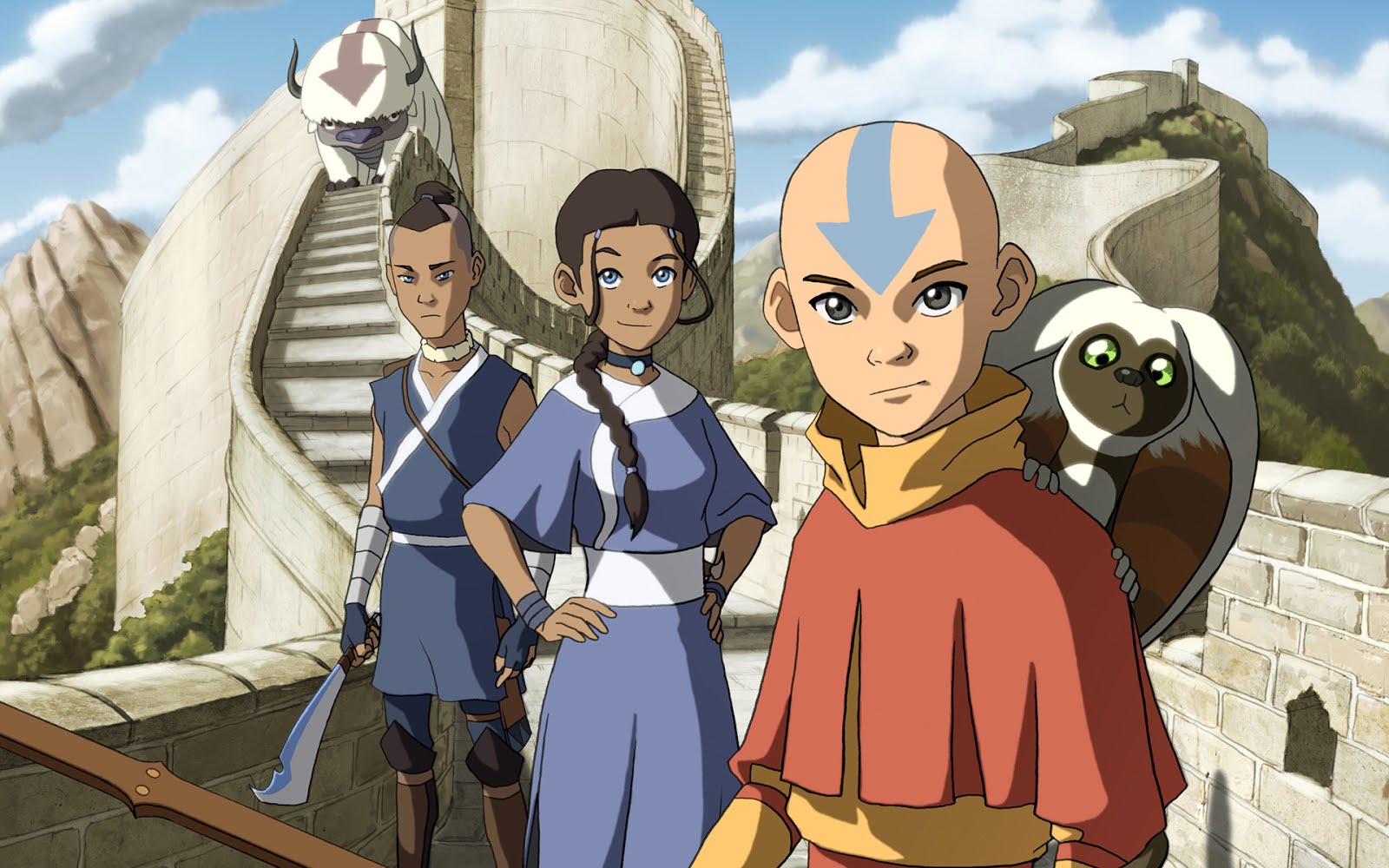

Avatar: The Last Airbender- When you think anime, you more than likely think Japan, but there are other nations contributing to the genre. While Avatar: The Last Airbender is clearly an American production, the influence of the far-east is very apparent. An American anime sounds like a great idea, and it is. Mixing two cultures can be a wonderful thing.  

Note: Target audiences are a real thing, but assuming they’re Berlin Wall-like dividers between who can and can’t enjoy a piece of entertainment is wrong.

I enjoyed Book One, season one, but the biggest issue could be summed up like this. A young target audience doesn't excuse bad writing. Indeed there are well written “kids” shows, which is why I find the repetitive episodes of Avatar quite irksome. Aang, Katara, and Sokka arrive at a village, do something incredibly stupid to get themselves noticed, the Fire Nation arrives, fighting ensues, and then they escape after learning some sort of morale lesson. When roughly half of the season follows the same exact formula, there’s a problem.

The similarities between Avatar: TLAB and Naruto are also distressing.  Aang’s struggles with being the Avatar and the power which comes with it is almost identical to Naruto’s difficulty with being a jinchuuriki.  Hell, they even call them spirits and both character run the risk of losing control of themselves as they’re inner power consumes them.

I know it seems like I’m really ragging on Avatar, but the truth is I am enjoying it. The large cast has only a single weakness, Zuko, and there’s a solid mixture of laughs and accessible progression. It’s a light-hearted journey which does a  good job of not feeling outdated, despite it’s occasional lack of originality. The core trio are fun to watch, but Katara is the high point as she doesn't fit one particular character archetype. Sokka is good for a chuckle most times he opens his mouth and Zuko’s uncle is the goofy yet wise “cool uncle” you’ve always wanted.

Animation is top-notch, which should be no surprise considering Nickelodeon can throw money around like a reformed Scrooge McDuck. Appreciatively, there is a mixture of culture in both the style and subject. I wish they would be a bit more creative, but again, there’s a permeating thought that since this is Nickelodeon, it has to be overly simplistic.

While far from the country to genre bridge I was lead to believe it is, Avatar: The Last Airbender is not an all too shabby entry into the world of anime.

Friday, January 10, 2014

I Watch Things Too #12: Some Good Ol' American Cinema


The Wolf of Wall Street- It’s nice when a movie doesn’t flaunt that it’s grounded in truth. As if that inherently means the final product is of greater quality than a work of fiction. Scorsese's over-indulgent three hour telling of stockbroker-gone-wrong, Jordan Belfort’s, whirlwind life is about as good as 2013 cinema got.

TWoWS is a damn long movie and you feel it. It’s rarely a slog though, as most scenes create this surrealistic world of average-joe fantasies. The everyday folks like you and I are meant to look upon Belfort and his entourage in a mixture of disgust and amazement. Their manipulation of the stock market and life of extreme excess is something we both desire and feel wronged by. TWoWS captures this wonderfully, especially in its surprising comedy. Half the time your laughing it’s the sort of situation where you say “ no way they do this. Oh, shit they’re actually doing it, those rich fucking bastards.”

Another clever touch is how Belfort’s scheme is never actually explained. As both the protagonist and occasional narrator, he’ll get partway through the finer details and then say “fuck it! They aren’t important. The point is the stock market is the the puppet of those in charge, and we’re getting rich off it.”

That right there is a message folks.

As expected, DiCaprio sinks into his anti-hero role as Belfort beautifully, as does the rest of the cast. The big surprise though is Jonah Hill as Belfort’s best friend, Donnie Azoff. Now Moneyball had him showing off his acting chops but this time around he’s a true co-star.

The Wolf on Wall Street is unsurprisingly one of the better films of 2013. Most scenes are worthwhile, even when predictable. If you plan on going to the theater anytime soon your choice should be clear. Just make sure you’ve gone to the bathroom first.


Mushi-Shi (OVA)- When I finished the original series early this year only to find there was no word of any continuation after an inconclusive ending, I was rather disappointed.Now is a time for Mushi-shi fans to rejoice. Not only is there this extra-long OVA, but season 2 is airing this April.

Despite taking over six years off, Mushi-shi hasn’t missed a step. It’s still one of the most unique anime out there. The trademark serene and mysterious atmosphere captured so well is back, but this time it’s supported by some of the most gorgeous animation I’ve ever seen. Visuals were a strong point in the past, but every little detail comes to life in the OVA.

While a forty-five minute episode is all we’re getting for now, not a single portion failed to captivate me. Mushi-shi never overplays it hand. It’s got a lot to say but never shouts. The viewer is simply invited to see down, have some tea, and listen in child-like wonderment.  Alongside Space Dandy, the return of Mushi-shi is easily my most anticipated anime of 2014.


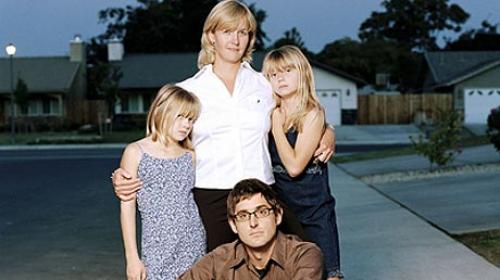
Meet America’s Nazis- The ipecac of documentaries. Seeing two little girls Sieg Heiling and singing hatefilled music at skinhead rallies is infuriating. Everyone Louis Theroux meets is admittedly interesting, but for all the wrong reasons. The main focus is infamous Tom Metzger, leader of the White Aryan Resistance. Surprisingly, he comes off as a half-assed racist and even hypocritical for reasons I’ll let you find out for yourself. The person I find most intriguing though is his agent, John, who clearly has some sordid past with drug-trafficking and only follows Metzger because he’s the one person who would hire him.

Really, if you’d like to watch a British man look incredibly uncomfortable around a bunch of grotesque racists, watch this. Or if you’d like to educate yourself about America’s troubles with racism, it’s got you covered there too.


The Hunger Games: Catching Fire- Early within the first Hunger Games it’s clear the book surpass the film in numerous regards.

Catching Fire is a different case.

If the original film was Katniss’ origin story, than CF is her first moment of great internal conflict. It’s not just about surviving. There’s a struggle between the part of her that wants a normal life, and the other half which feels duty-bound to be the icon of the resistance. There’s also the whole love triangle mess, but thankfully it’s pushed to the side more often than not. What would have been more ideal is stronger portrayal of the sham of a relationship between Katniss and Peeta. Even so, this is a story of resistance, and an enjoyable one, despite the twist being somewhat telegraphed.  

Rather than play the same cards twice- which I suspected would happen- CF does a better job of world-building and character development. Yes, a second Hunger Games is held, but it’s not the focus. We get what we need out of it -and the non-essential bow and arrow fodder- and then move on. The supporting cast is far better too. Peeta is fleshed out and even rivals Katniss in importance. Effie shows she’s more than a stuck-up Capitalist. Gale...well, Gale is still incredibly worthless and annoying, but he’s more of an tertiary anomaly.  Even the new faces throw a few wrinkles into the mix.

I admit, I wasn’t a big fan of the first and I’ve never read the books, but Catching Fire has me interested in seeing how things play out.


Lone Survivor- Hey, remember when I mentioned it’s cool when movies don’t flaunt their factual foundations as a cheap gimmick? Yeah, well…

Okay, so maybe the purpose of said flaunting is to educate the audience on what the men and women of our military have really been up to for the past decade, but Lone Survivor feels more like bad military recruitment than what it seemingly aims to be. The four-man Navy SEAL team is painted as these All-American heroes, even slinging out cheesy one-liners such as “ I’m not dying for my country, but you can die for yours.” When the bullets are flying every which way, its increasingly obvious. I am well aware how skilled Navy SEALs are, but when they're outgunned 100+ to four, and are pulling off head-shots left and right while suffering from numerous gunshots, shrapnel wounds, and other severe injuries, it becomes near comical.

Most egregious are the extended scenes where they’re falling down a cliff in ragdoll fashion; hitting rocks and trees along the way. It reminds me of the insurance fraud missions in Grand Theft Auto, where your character seems almost magnetically-and hilariously- attracted to every deadly object.

We get it, SEALs are tough mother fuckers, they’re “American Heroes,” and you want the audience to fawn over them. You want us to aspire to be them. No need to drag out the rather lackluster gunfight or create some mediocre war-porn though.

You know exactly where the story is going the entire time thanks to the title and early scene revealing the “Lone Survivor.” That’s all well and good. It’s a proven mechanic, but the journey isn’t all the exciting. The best sequence is when a village defends Mark Wahlberg’s character against the Taliban, but even that’s not all too good.

I know I’m being harsh and you might suspect I think Lone Survivor is an awful film, but it’s not. It does a few things wrong, and what it doesn’t do wrong, is does averagely. I appreciate the effort to try and tell the story of a Navy SEAL mission gone tragically awry. It’s important the public knows the truth, but the execution failed to meet its mark. Multiple Americans died in vain and trying to turn that into an inspiring story / recruitment movie is misguided.

Monday, January 6, 2014

I Watch Things Too: Welcome to the NHK

Welcome to the NHK- I was originally going to include this in the next edition, but NHK is far too important to me. Where discussion fails me, writing is my means of expression. An outlet by which the true Jamison Miller can connect to the world he occasionally feels alien in.


So please, read this with an open mind.


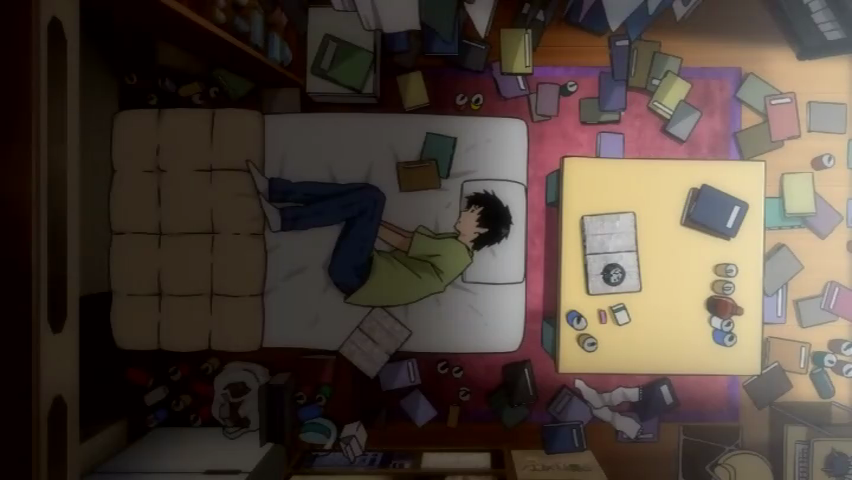
NHK is the anime rendition of Catcher in the Rye, a favorite of mine, for the modern day. As a 22 year-old hikikomori, Sato struggles with the purpose of his life. He moved away from home four years ago in order to attend college in Tokyo, but quickly dropped out in his first year and settled into a solitary lifestyle.


While stumbling in the last few episodes, holistically NHK is arguably my favorite piece of entertainment. That includes movies, shows, books, and even my biggest passion: video games. For me, Sato is the most relatable character I’ve ever encountered. The empty feeling of being a young adult, living on your own, not being all that social, and questioning where life is going to take you is something I know well. Countless times I’ve sat in my apartment- much like Sato- and questioned all the decisions I’ve made. Why do I dive deeper into debt for the sake of a college degree with questionable value? Why do I have trouble relating to others? And when the hell can I take the next step and truly define who I am?


Even in an ending proceeded by some weaker episodes, I truly understand the message. Life isn’t about overcoming your deficiencies. It’s about accepting them as apart of yourself and building an existence with the people you care about.


If you would ever like to truly understand me as a human being, then watch NHK. Not only is Sato the exaggerated Japanese version of myself, NHK exemplifies why I write about the things I love. They’re a means by which we can all relate to one another. Through them I’ve grown to understand that being judgmental and close-minded only serves to hinder your enjoyment of life. Views I had once not held have been made apart of my philosophical beliefs.


I feel we all have a piece of entertainment which defines who we are and helps to shape our future selves. Welcome to the NHK is my apogee of storytelling and something I hope you all can experience and learn from. Its character rapport will make you deeply contemplate your own relationships and their merits. There's also a healthy balance of comedic relief. Sato's paranoia often creates for some rather hysterical internal dialogue between himself and the inanimate objects of his apartment which embody his self-conscious.

I rarely rewatch or replay much of anything these days but NHK had me coming back for more the day after I finished.

Much like the cast it's centered around, it's a flawed masterpiece which reflects a subset of society with unadulterated verisimilitude. I love its strengths and I love its flaws; and I hope you'll give yourself a chance to fall in love with them too.

As articulate as I like to pretend I am, the piece linked below is from NHK's soundtrack and does a far better job of explaining what it's all about.


American Horror Story- There are some shows I have a mild interest in but after constant praise I give them a shot. American Horror Story is one of them.


Now I like horror, and despite the obvious problems posed by introducing the genre to television, the miniseries approach of AHS seems like a valid solution, but you wouldn’t know it from watching. My usual rule-of-thumb is to give five or six episodes before sprinting for the escape pod; AHS didn’t even last that long. It took me a whole three episodes before I abandoned this schizophrenic mess.


Episodes rarely settle into any sort of pace or place. They jump back-and-forth between several incoherent stories which range from “where’s the remote” to “hand me the closest heavy object capable of breaking the TV.”


The finishing blow though is the simple fact that AHS fails as a piece of horror. The jump scares are incredibly predictable and there’s a lack of tenseness thanks to undistinguished and sterile cinematography. Yes, there’s an air of campy weirdness, but being strange for the sake of it is hollow.


There’s a bad pun to made about the quality of AHS, but I think you get the point. American Horror Story is atrocious.


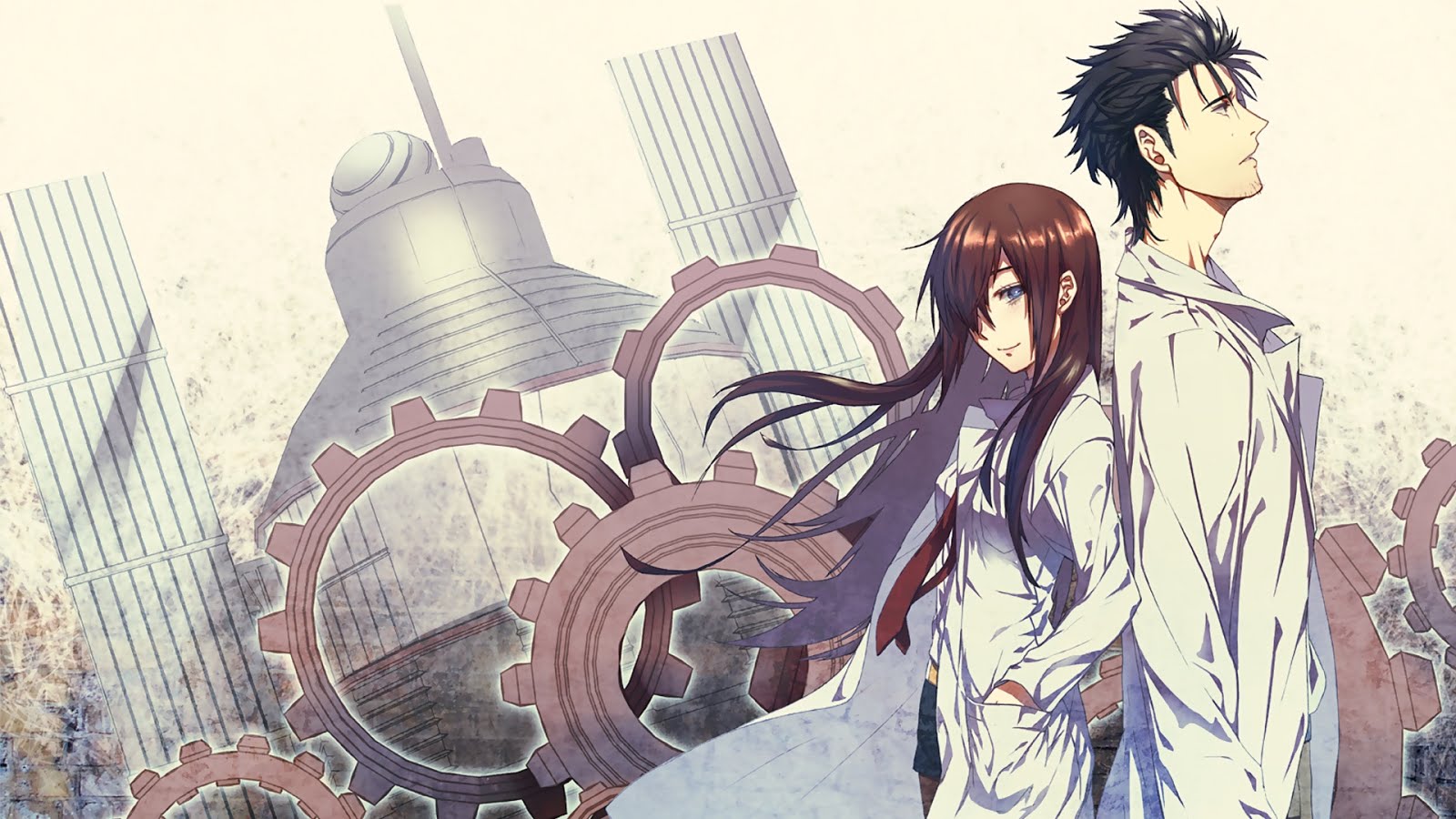
Steins;Gate- I’ve had a long-running fascination with time travel since watching Back to the Future as a kid. While not wholly realistic to the base concepts, BttF cultivated a fascination for the highly complex and paradox riddled subject. Naturally, Steins;Gate drew my interest. When fiction delves into time travel, it can often become convoluted. If plot holes are avoided, what comes out the other end can be an exceptional. Case and point, Steins;Gate.


In many ways the mold is reformed and broken. Okabe, the protagonist, has a female childhood friend, Mayuri, who isn’t all there, but it’s never outright said. Characters react to her in a natural manner. She’s unique but not token. The same could be said of Okabe, or most of others, the self-proclaimed mad scientist. The cast is such a hodgepodge of familiar and new that’s it near impossible not to get caught up in their lives.


While starting off seemingly innocent and light-hearted, things get serious with some heavy moral quandaries about manipulation of past events. I’ll unashamedly admit there was a moment where I actually curled up into a ball as a single tear rolled down my cheek.


Sadly to discuss any further may tempt the spoiler gods, and I wouldn’t want to rob you of the amazing ride. I often predict twists, but Steins;Gate does an exceptional job of pulling the curtains at the most opportune times. Finding a weak episode is a difficult task- and while it’s not my favorite anime- I’m inclined to say it’s the most technically sound.


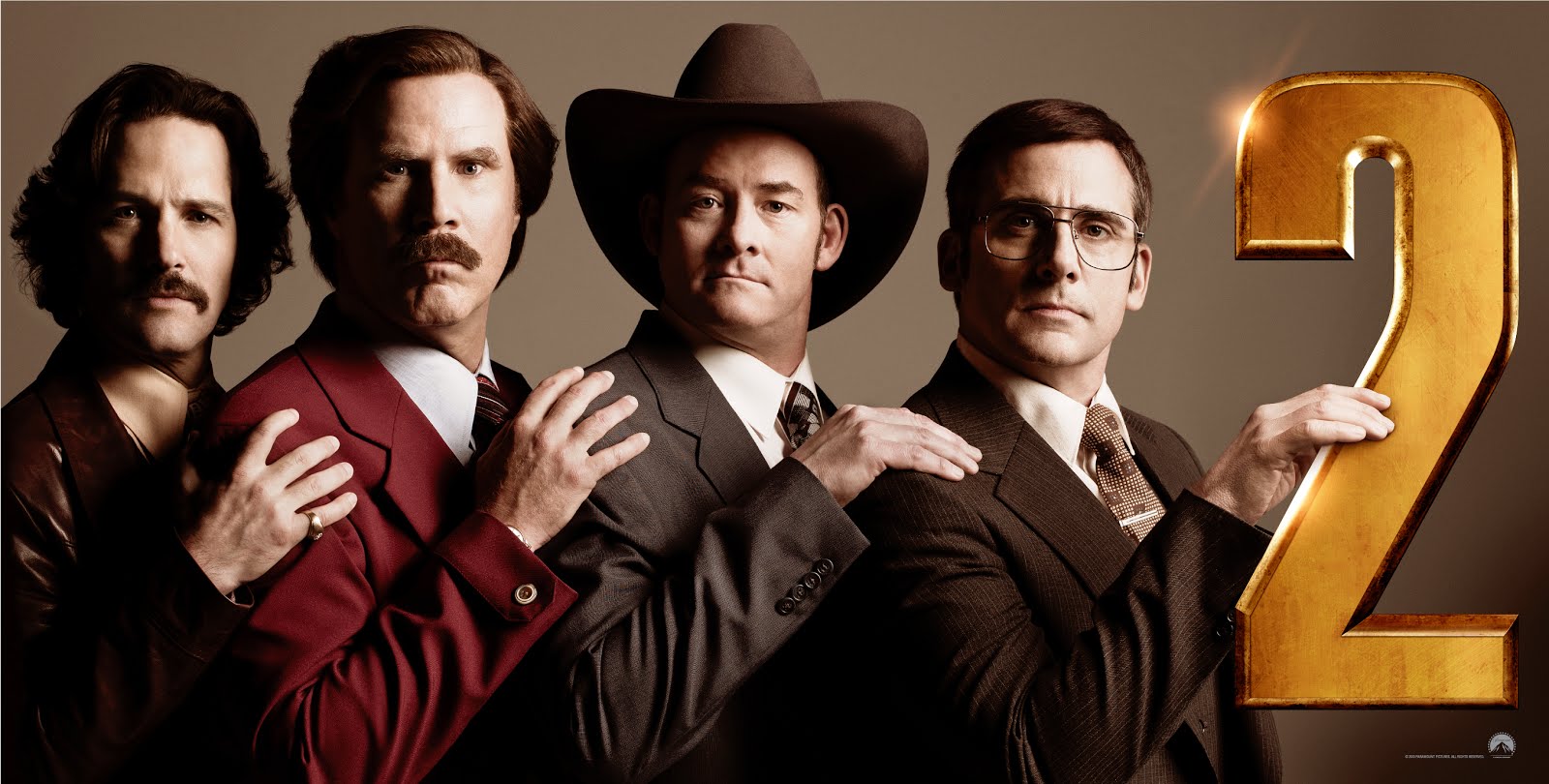
Anchorman 2: The Legend Continues- Firstly, I need to admit I’ve never actually seen the entirety of Anchorman. Partly because I’m not a huge Will Ferrell fan- but what I've seen- I enjoy. Going to see Anchorman 2 in theaters wasn’t my first choice. Comedy sequels tend to miss the mark of their predecessors. Indeed, Anchorman 2 isn’t a barrage of constant big laughs, but I departed satisfied.


The biggest issue I take is in how far the style of comedy is taken at times. It’s stupid. No if, ands, or buts about it: Anchorman 2 is as dumb as it gets. But for the majority of the film, it’s a good dumb. Occasionally jokes miss their marks or drag on for too long. Easy humor is fine, but make sure you delivery it creatively. Change things up. Comedy is all about expectation management. Sometimes this is forgotten.


Mostly, it succeeds. The scene where Ron Burgundy starts getting it on with his black boss and random pictures of famous black people are strewn throughout in a montage style is hilarious. Or in the finale- which I’ll avoid spoiling- but know that it takes the crazy to a whole new level.


Anchorman 2 is a steady trickle of small laughs with the occasional dry spell and the even more rare big laugh. It’s probably better than it deserves to be, especially with an overarching satire of the decline of modern news media, which is out of place. There’s no need to rush out and spend an exorbitant amount of money on tickets, but at the same time, you’ll likely do so anyway thanks to the hype-train.


So heads up. If you enjoyed the first, you’ll likely find your time well spent on the second.


Out There- Undeniably, homosexuality is one of the most hotly debated topics of our age. Which is sort of embarrassing considering we’ve been around for a fair few years. If you consider yourself a decent human being and a responsible citizen, it’s necessary to educate yourself on such important societal issues. One way of doing this is by watching documentaries.


Stephen Fry- British comedian, actor, and activist- decided to take it upon himself to tour the world and visit countries where such a topic is...well, topical.


As a gay man, Fry clearly has his own views on the matter, but Out There does a great job of exposing the utter bullshit the LBGT community has to live with. While part of the world may seem fairly progressive, there are those who are regressing. Ghana and Russia are two big examples shown in detail during this two-parter.


But it’s not all about attacking those in the wrong. The overarching message is clear. Respect, or at the very least tolerance. Even if you don’t fully agree with Fry’s views or approach, the facts presented are real and sobering. The world is not as accepting as it pretends to be.


In summary. If you’re not a brainwashed and close-minded person filled with disdain for people who are not affecting your life negatively, you’ll likely find Out There rather enjoyable and educational.